
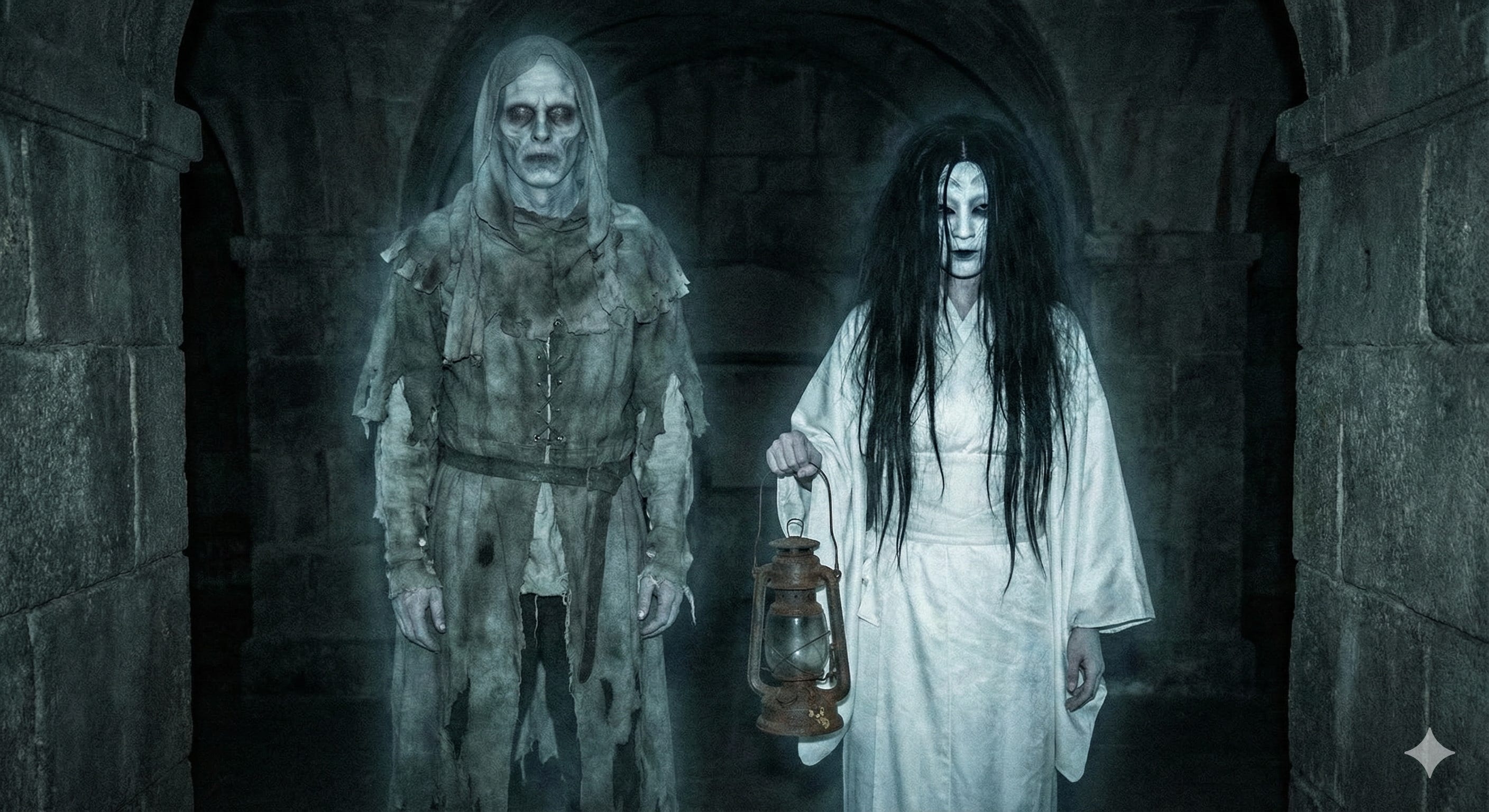
The way we perceive the unseen world says more about our living values than the dead themselves. While the paranormal is a universal human experience, the interpretation of a cold breeze or a moving shadow changes radically. These differences are rooted in thousands of years of philosophy, religion, and social structures.
The Foundation of Reality
In the Western tradition, heavily influenced by Abrahamic faiths and Greek logic, the universe is often viewed as a linear progression. Life begins at birth and concludes with an eternal destination. This creates a dualistic worldview where light and dark, or good and evil, exist in constant opposition. Consequently, a ghost is often seen as an anomaly or a soul that has lost its way on the path to the afterlife.
Conversely, Eastern thought is built upon cycles and interconnectedness. Through the lenses of Buddhism, Taoism, and Hinduism, existence is a wheel of rebirth known as samsara. In this framework, the spirit world is not a separate realm of evil but rather a different state of being within the natural order. Spirits are fellow travelers who may be experiencing a difficult transition due to karma or unresolved attachments.
Malice Versus Misfortune
The characterization of spirits also differs significantly. Western folklore often highlights the demon, an entity that is inherently malevolent and seeks to corrupt. These beings represent a rebellion against the divine order.
In the East, spirits like the Hungry Ghost are defined by suffering rather than malice.These entities are depicted with tiny necks and large bellies, symbolizing a state of constant, unquenchable desire. They are not necessarily evil in a moral sense; they are tragic figures who require assistance or merit from the living to find peace.
Methods of Solving Paranormal Disturbance
Western view sees the paranormal as a breach of the natural law, the primary response is often confrontation. The goal of an exorcism or a cleansing is to banish the intruder and restore the boundary between the living and the dead. This is an act of spiritual authority where the entity is commanded to leave.
Eastern traditions prioritize harmony and appeasement. If a location is haunted, a practitioner might look at the flow of energy or check if ancestral rites have been neglected. Instead of banishing the spirit, the living might offer food, burn incense, or chant sutras to generate positive karma for the deceased.
Conclusion
The paranormal is not a source of terror but a reminder of the enduring bonds that transcend the physical world. This comparison illustrates how cultural frameworks shape our deepest fears and our highest hopes.